
Ceremonial vs culinary matcha: what's the difference?
Ceremonial, culinary, premium: these labels are not regulated. Here is what they really mean, and how to choose a matcha based on how you plan to use it.
The labels "ceremonial" and "culinary" are meant to describe two uses: a smooth, refined matcha to drink plain from a bowl, and a bolder one designed for lattes and baking. But be careful: these terms are not regulated, and every seller uses them in their own way. To choose well, look at colour, origin, ingredients and how you will use it; for a latte, a good-quality organic matcha is more than enough.
What do "ceremonial" and "culinary" really mean?
In Japan, matcha has long been linked to the tea ceremony, where it is whisked in a bowl and drunk plain. The term "ceremonial grade" appeared mostly in Western markets to describe matchas considered worthy of that moment: the smoothest, greenest and least bitter. "Culinary grade", on the other hand, refers to matchas meant to be mixed with milk, desserts or smoothies.
The problem is that no official standard defines these categories. There is no shared specification setting the harvest, colour or minimum taste required to print "ceremonial" on a pack. Between two brands, a "ceremonial" matcha can therefore be very different. You will also see other labels such as "premium", "latte grade" or "barista", just as loosely used.
How do harvest and processing differ?
The quality differences themselves are real. They mainly come down to three factors:
- Harvest: the first spring leaves, young and tender, are the sweetest and richest in L-theanine. Later harvests give more mature leaves with a stronger, more astringent taste.
- Shade-growing: the more carefully it is done, the greener and sweeter the leaf.
- Grinding: a very fine powder dissolves better and gives a silkier texture.
Matchas sold as "ceremonial" usually come from the first harvests, while "culinary" ones often come from later harvests.
Colour, taste and price: how can you tell?
- Colour: high-quality matcha is bright, almost vivid green. More ordinary matcha leans towards olive or yellowish green. A brownish powder often points to oxidation or poor storage.
- Taste: a smooth matcha is vegetal, rounded and slightly sweet, with an umami note. Culinary matcha is more bitter and astringent, which is not a flaw once mixed with milk or the sugar in a cake.
- Price: first harvests cost more. Still, be wary of a very high price justified only by the word "ceremonial", with no information on origin or ingredients.
For more on what to look for, read our guide on choosing the right matcha.
Which matcha for which use?
For a plain bowl (usucha), the matcha's flavour is the star: go for a bright green, smooth, finely ground powder and prepare it with water at 70–80 °C.
For a latte, hot or iced, the milk softens any bitterness. A good-quality organic matcha, green, pure and free of additives, is more than enough: there is no need to hunt for the most expensive label. Try our homemade matcha latte recipe.
For baking, such as cookies, cakes or creams, matcha is heated and mixed with butter, sugar and flour. A matcha with a bolder taste actually comes through better. Our matcha cookies are a good example.
Whatever the use, what matters most is a pure matcha: no sugar, no milk powder, no added flavouring. Some blends sold as "matcha latte" are mostly sugar, so always read the ingredient list.
What about Matchaholic matcha?
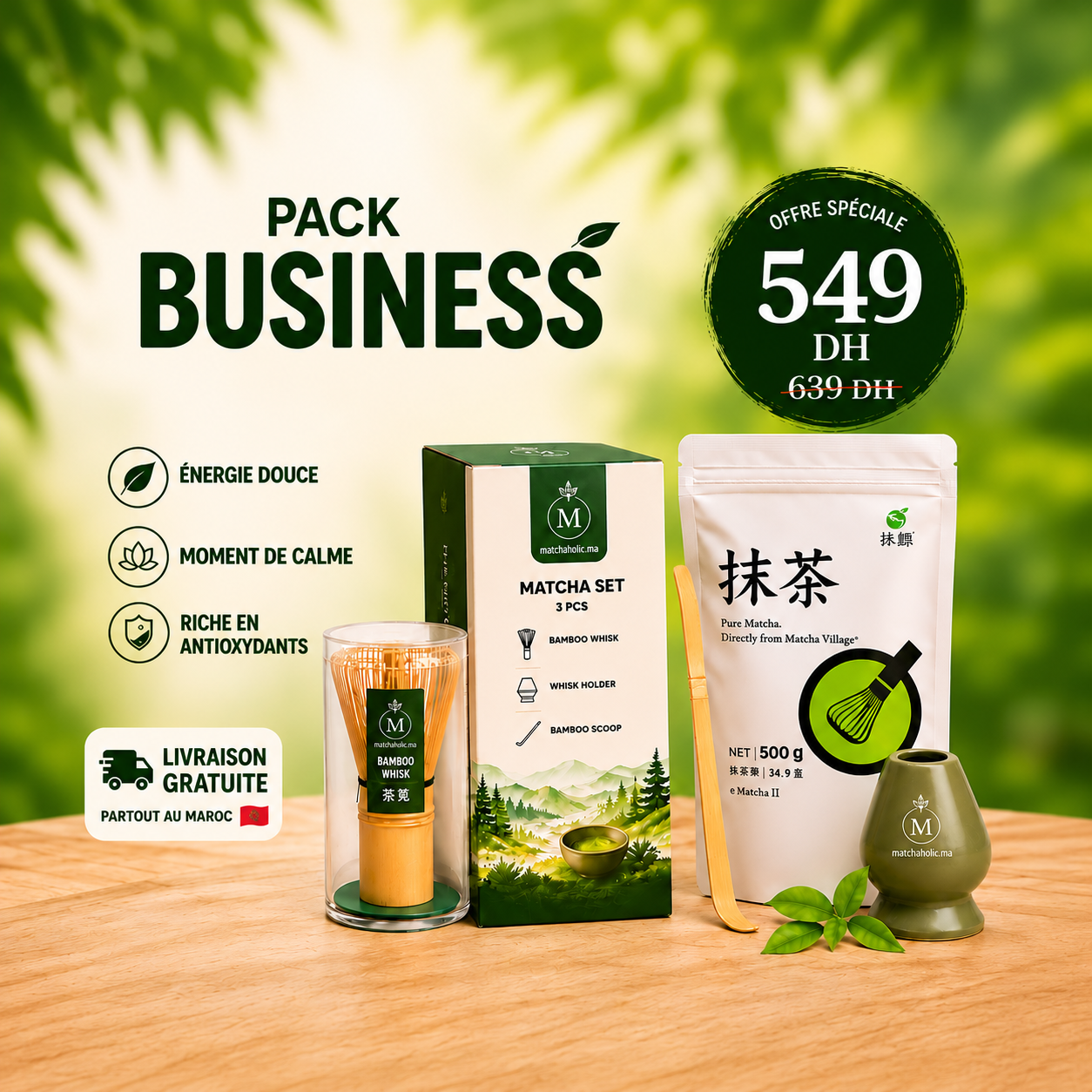
Our Pure Matcha powder is 100% organic matcha from Japan, with no sugar and no additives. It works just as well plain in a bowl as in a hot or iced latte, and it is happy in baking too. At the time of writing, the 100 g pouch (about 50 cups) costs 189 MAD. For easy measuring, the 100 g pack with bamboo scoop is 199 MAD; if you drink it daily or bake with it often, the Comfort Pack 500 g with essential kit is 549 MAD. Prices may change, so check the product page. Delivery is free anywhere in Morocco, with cash on delivery.
In short
So-called "ceremonial" matcha first, so-called "culinary" matcha second:
- Label status: not regulated / not regulated
- Usual harvest: first spring harvests / later harvests
- Colour: bright green / duller green, sometimes yellowish
- Taste: smooth, rounded, umami / more bitter and astringent
- Price: higher / more affordable
- Best use: plain bowl / lattes, baking, smoothies
- What really matters: purity, origin, freshness / purity, origin, freshness
FAQ
Is "ceremonial matcha" a regulated term?
No. No official standard defines "ceremonial" or "culinary": each brand uses these words freely. Rely on colour, origin and ingredients instead.
Can you use ceremonial matcha in a latte?
Yes, but you don't have to. Milk softens the taste, so a good organic matcha that is pure and bright green is more than enough for a delicious latte.
Can you drink culinary matcha plain?
You can, but it will often be more bitter and astringent. It is mainly designed to be mixed with milk, smoothies or baked goods.
How can you tell good matcha?
Good matcha is bright green, finely ground and made only of powdered green tea, with no sugar or additives. A yellowish or brownish colour often signals lower quality or poor storage.
For this recipe
What we use
Blog
Read next
Matcha and weight loss: what's true and what's exaggerated
Matcha will not make you lose weight on its own. Its real strength is replacing sodas, frappés and very sweet teas with a sugar-free drink. Here are the facts versus the hype.
Does matcha keep you awake? Caffeine, timing and tips
A cup of matcha contains 60 to 70 mg of caffeine, which stays active for several hours. Here is when to stop and how to enjoy it without ruining your nights.
Drinking matcha on an empty stomach: good or bad idea?
Matcha on an empty stomach suits some people and makes others queasy. It all depends on your stomach: here is how to enjoy it in the morning without discomfort.